
astronomy.de
Astrophotography by H.Dannhoff
Supernovae
Latest SN-Data: Bright Supernova
H. Dannhoff
Far developed stars are changed or completely destroyed by disastrous explosions. Supernovae develop extreme brightnesses for one whole galaxy like M33 comparably.
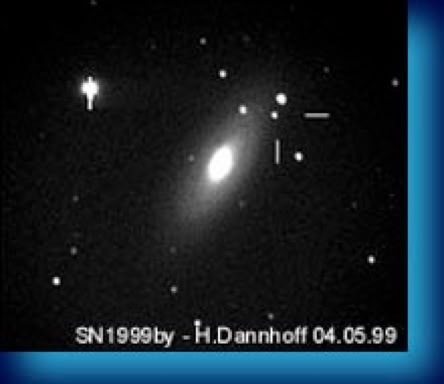
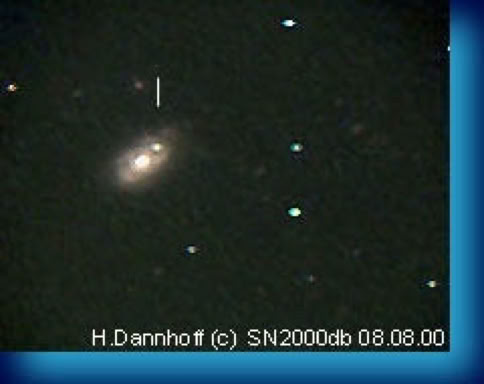
General
Stars are which ones Supernovae be at the end of her development. By an explosive process they lose one large portion of her matter or are destroyed completely. So already 1934 W. Baade and Zwicky p. recognized this process and started with a systematic supervision at the Mount-Palomar Observatory. The brightness increase of the Supernovae is likes up to 20. The brightness increase is greater than with a Nova up to 100000.
Name
The name of a supernova discovered newly consists of the date with appending lat. letters, increasing alphabetically.
Classification
Supernovae are classified mainly after her visual spectra. You are subdivided into two main groups, type I and type II. The type I is at Supernovae unlike the type II, no hydrogen lines in the spectra. The type I subdivides himself into three subgroups once again:
Type Ia: An absorption line is produced at 620 nm of the once ionized silicon at this type.
Type Ib: The above-mentioned line does not appear the absorption line of the neutral helium, for this here. This line is missing at the type Ia (or is represented only weakly).
Type intercity: Here lack the helium and silicon lines shortly after the brightness maximum.
One states many months after the brightness maximum the type Ia at the Supernovae predominating issue lines the cobalt and iron firm. One finds issue lines of the oxygen and calcium at the type Ib and type intercity.
II are still the hydrogen lines the type availably at Supernovae after months, too.
Bigger difference between Supernovae and type II is her brightness course in the visible spectral range the type I. The increase to the brightness maximum lasts for some days at the type I and then removes quickly. After a month fells the brightness likes and reduces itself at 3 around the half after approx. 11 weeks.
The increase is very fast at the type II to the maximum. The brightness course after the maximum is then rather uneven.
Brightness lies the absolute with the type Ia on an average likes at-19 , intercity likes at approx.-17.5 and at the type II at-17 likes at type Ib and type. It is mean average values at here. Deviations to 2 likes are possible.
The remains of the Supernovae
At a supernova explosion matter is catapulted into the interstellar room. The shells, consisting of gasses are visible well of the earth.
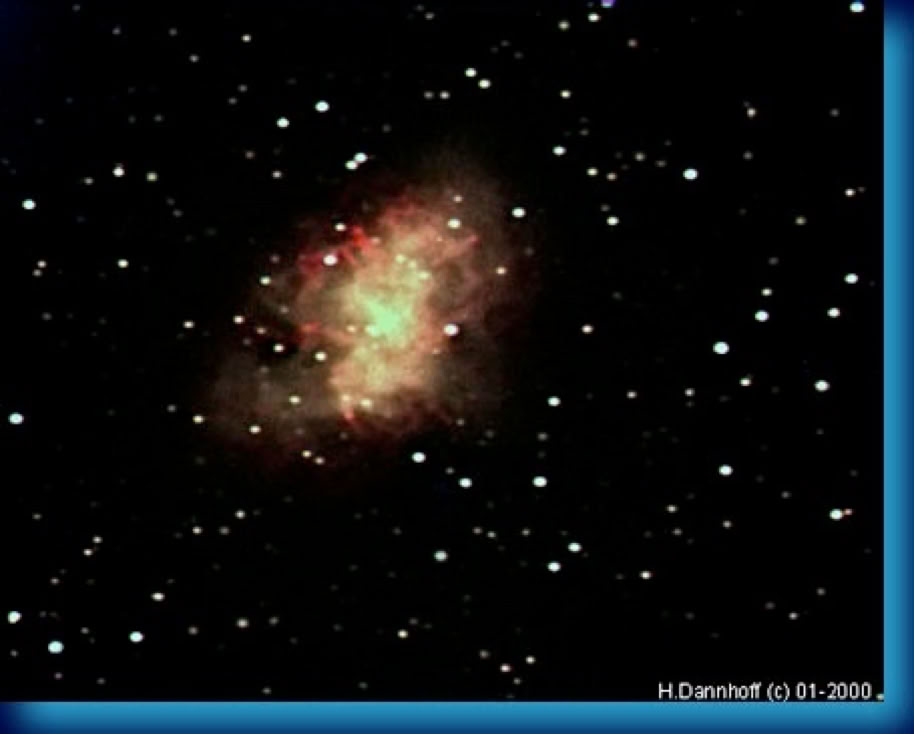
The crab-nebula M1 is well known (see picture). He is already visible in little telescopes.
Neutron stars are further possible stellar remains after a supernova explosion.
Supernovae lie in which surroundings
One finds the type Ia the Supernovae very frequent in elliptical Galaxies. You originate from a Sternenpopulation with older and mass poor stars. The Supernovae is the type Ib, type intercity and type in spiral systems or irregular Galaxies in H //ii// //ii// -- areas with high starbirth-rate mostly. These Supernovae are apparently itself very young stars.